
Custom Home Design vs Documentation: Why Design Comes First
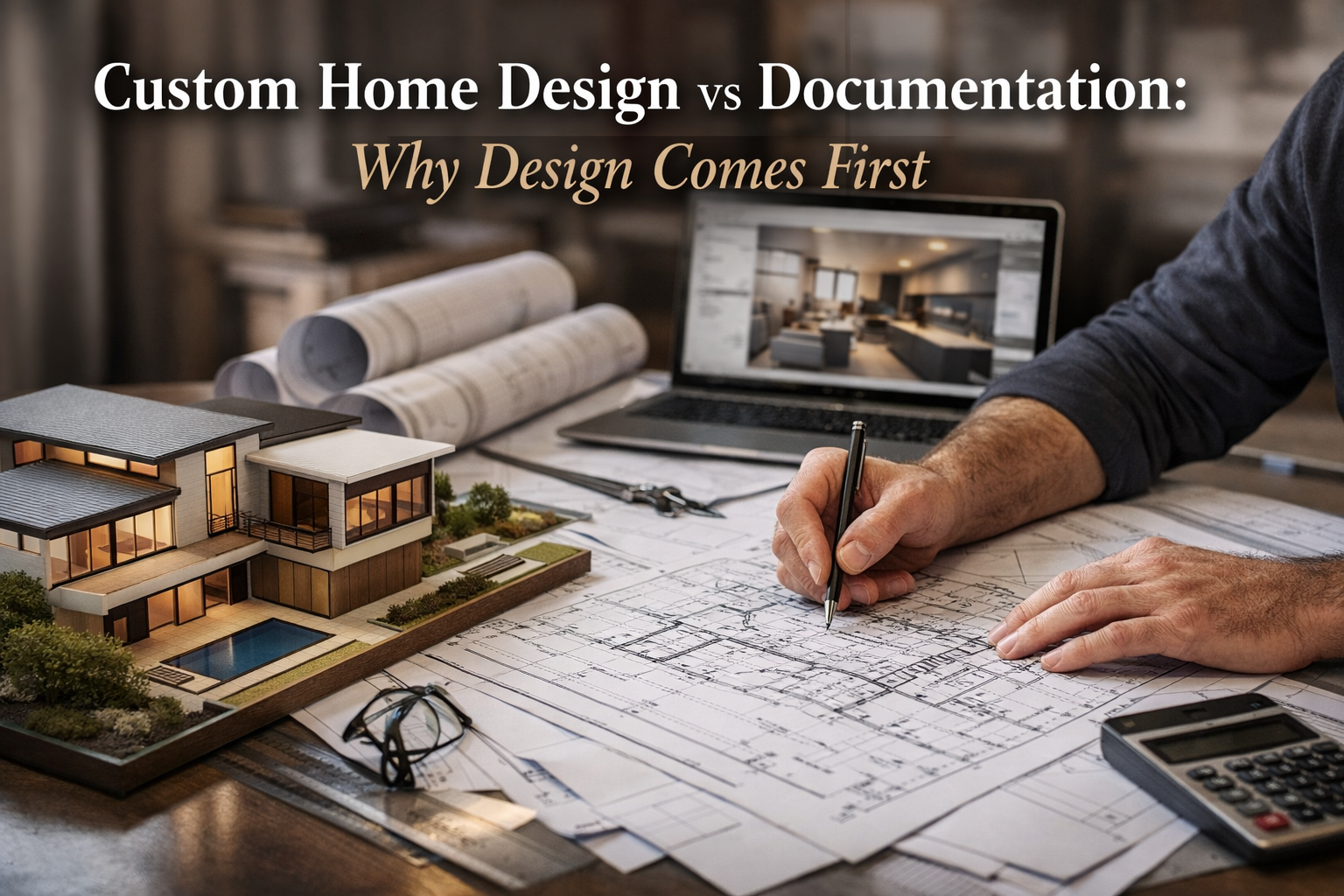
When planning a custom home, many homeowners ask whether they can go straight to documentation. Floor plans, working drawings, permits, and approvals feel like the logical place to begin. After all, these are the documents required to build.
In reality, the most successful projects start earlier. The real difference between custom home design and documentation lies in purpose, timing, and long-term outcome. When design comes first, homes are clearer, more considered, and far less likely to be compromised by late-stage decisions.
At Sketch, we see the consequences when documentation leads and design follows. Homes that technically work but never quite feel right. Layouts that meet regulations but fail to support the way people actually live. Projects where costly changes occur simply because the design was never fully resolved.
Understanding why design must come before documentation is essential if you want a home that is truly bespoke rather than just custom on paper.
What is custom home design?
Custom home design is the strategic and creative process that defines how a home will function, feel, and respond to its environment long before drawings are finalised. It considers how a household lives day to day, how spaces connect, how light enters the home, and how the building sits within its site.
This stage explores possibilities rather than locking them in. It tests ideas against orientation, planning controls, privacy, budget, and long-term flexibility. Good design thinking identifies problems early, when they are still easy to solve.
Design is not about decoration or aesthetics alone. It is about structure, proportion, flow, and intent. It creates a clear framework that guides every decision that follows.
This approach sits at the core of our residential design process, ensuring every home begins with clarity rather than assumptions.
What is documentation?
Documentation is the technical translation of an approved design. It includes construction drawings, planning submissions, consultant coordination, and compliance information required for permits and construction.
Documentation answers the question of how something will be built, not what should be built. It is precise, detailed, and essential, but it is not the right stage for discovering layout logic or rethinking spatial relationships.
When documentation is forced to carry unresolved design decisions, compromises often follow. Changes become expensive. Consultants work reactively. Builders receive drawings that lack clarity. The result is friction throughout the build process.
Documentation works best when it follows a resolved design rather than trying to create one.
Why design should always come first
Design-first projects consistently deliver better outcomes, both aesthetically and financially.
When design leads, decisions are intentional rather than reactive. Spaces are sized correctly from the beginning. Circulation feels natural. Orientation and privacy are resolved before walls are fixed on paper. Budget is controlled because the brief is clear.
This approach also reduces changes during documentation and construction. Builders can price with confidence. Consultants work from a shared vision. The home that is built closely reflects the home that was imagined.
For many Melbourne homeowners, where planning controls, site constraints, and neighbourhood context play a significant role, early design thinking is especially important.
The risk of skipping proper design
Some clients come to us with documentation already underway, hoping to refine the design later. While improvements can be made, the opportunity for meaningful change is often limited.
Once documentation begins, early assumptions become embedded. Orientation decisions may already be fixed. Room relationships may be compromised. Storage, light, and flow may not fully support the household’s needs.
Design is the stage where problems are cheapest to solve. Documentation is the stage where they become costly.
How design improves documentation quality
When design is properly resolved, documentation becomes more efficient and accurate.
Structural systems align more naturally with spatial intent. Service coordination improves. Planning submissions are stronger because the proposal is cohesive rather than pieced together. Builders receive drawings that are easier to interpret and execute.
This clarity carries through to construction and ultimately to the lived experience of the home.
You can see this relationship between strong design and build-ready documentation across our completed projects.
Design does not slow the process
A common misconception is that a design-led approach adds time or complexity. In practice, the opposite is often true.
Clear design thinking simplifies decision-making. It reduces revisions later. It prevents rushed compromises when deadlines approach. Most importantly, it gives clients confidence that their home has been properly considered before it is committed to drawings and approvals.
Design is not about adding layers to the process. It is about removing uncertainty.
Why premium homes demand a design-first mindset
Bespoke homes rely on nuance, proportion, and cohesion. These qualities cannot be retrofitted through documentation alone.
Premium residential design responds to site, lifestyle, and long-term value rather than templates or shortcuts. This approach aligns with broader architectural best practice, as recognised by professional bodies such as the Australian Institute of Architects.
Documentation ensures a home can be built correctly. Design ensures it is worth building.
How Sketch approaches design and documentation
At Sketch, we intentionally separate design thinking from documentation execution while ensuring both stages are closely integrated.
Design is where ideas are explored, tested, and refined. Documentation is where those ideas are locked in with precision. This approach protects design intent while delivering the technical clarity required for construction.
Our Melbourne interior design capability further strengthens this process by resolving materials, finishes, and spatial experience alongside the architectural design rather than treating them as an afterthought.
Frequently Asked Questions
Is custom home design different from drafting?
Yes. Drafting focuses on producing drawings, while design focuses on problem-solving, spatial planning, and long-term outcomes.
Can I go straight to documentation if I already know what I want?
Even with a clear vision, design helps test ideas against site constraints, planning controls, and lifestyle needs before they are locked in.
Does starting with design increase costs?
In most cases, it reduces overall costs by preventing changes during documentation and construction.
How long should the design stage take?
This depends on project complexity, but time invested in design typically saves time later.
Is design only about how the home looks?
No. Design addresses function, flow, orientation, sustainability, and usability as much as aesthetics.
Do renovations and extensions need design first?
Yes. Integrating new spaces with existing ones benefits significantly from early design thinking.
Do builders prefer design-led projects?
Most builders value well-resolved designs because they reduce uncertainty and variations.
Does Sketch manage both design and documentation?
Yes. We manage both stages to ensure continuity from concept through to construction-ready drawings.
What happens if my budget changes after design?
A clear design allows informed adjustments without undermining the overall integrity of the home.
Ready to start with design?
If you are planning a custom home or major renovation and want clarity before drawings lock in the wrong decisions, start with a design-led conversation.
Get in touch with Sketch to discuss how a design-first approach can shape your project from the very beginning.